
Whether you’re looking to be a bit more budget-conscious or to up your coffee-brewing game at home, the French press and pour-over are two of the most accessible ways to do so. The equipment is affordable and the processes are relatively easy to pick up. The question then becomes, which one is the best fit for your morning routine?
A quick primer
You’ll find that both methods will benefit from a little experimentation—which is one of their advantages, because, in time, you’ll be able to make a cup of coffee that’s tailored to your tastes.
To get started, here’s a basic overview of each process:

FRENCH PRESS
First, grind your beans. Coarse grounds are generally favored here because they tend to produce the balanced, full-bodied flavor French press coffee is known for. A good starting point is a 1:15 ratio, or three tablespoons of ground coffee to one cup of water.
Next, heat the water to between a simmer and a soft boil (200 to 205 degrees Fahrenheit). Add the ground coffee to the French press. Then pour the water over the grounds, filling the carafe halfway. The coffee typically takes around four minutes to brew. At the one-minute mark, use a spoon to gently but thoroughly stir it. Then add more water, filling the remainder of the carafe.
At the four-minute mark, slowly and steadily press the plunger down. Once the grounds are firmly pressed to the bottom of the carafe, pour out the contents to stop the brewing process and prevent over-extraction.
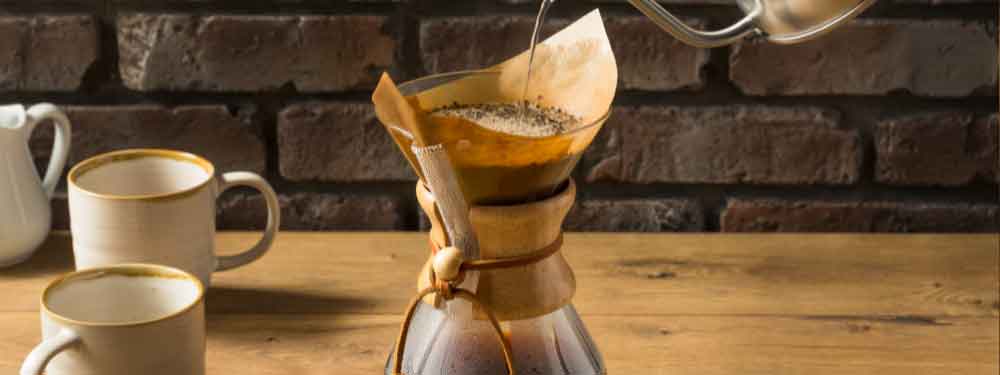
POUR-OVER
The first few steps are pretty much the same: Grind your beans. A coarse ground lends itself to the pour-over method, but feel free to try a finer grind once you get the process down. Aim for a 1:15 ratio, or three tablespoons of coffee to one cup of water, heated to 200 to 205 degrees Fahrenheit.
Before you add the ground coffee, pour the heated water through the empty filter into your cup or carafe. Then dump out the water. This will help get rid of the starchy flavor that can accompany some paper filters. Next, add the coffee grounds to the filter, and shake it lightly to ensure the grounds are level.
Create a small well in the middle of the grounds. Drizzle the water over grounds. This will release gases from the grounds. After 45 seconds or so, continue to pour, swirling the water and coffee gently until the cup or carafe is filled. Ideally, the bed of wet coffee grounds at the end is flat.
Which is right for you?
You’ve probably already gathered that both methods are a little more time- and labor-intensive than brewing drip coffee. But, oh, the coffee you’ll savor in the end. And after a few tries, you may come to think of it, as many others do, as methodical and contemplative, which is not a bad way to start the day.
Both are also very sensory experiences, rich with natural aromatics.
Perhaps their single greatest advantage is the control you have over each aspect of the process. You can adjust how finely or coarsely ground the coffee beans are, the temperature of the water, and, where the French press is concerned, how long the coffee steeps. Each step can have a significant impact on your cup of coffee.
What you want out of that cup is what should dictate your next steps. French press coffee is noted for its depth and intensity. It has a heavy body and a rich mouthfeel (think Americano). Pour-over coffee, on the other hand, tends to produce a milder, smoother, cleaner flavor. In this way, it’s perhaps a little more versatile.
If you’re drawn to both descriptions, there’s no harm in trying both methods. Variety is the spice of life.