
Coffee-making, for you, is a ritual. Your burr grinder is set to grind exactly the amount you need at the precise level you prefer. You heat your water—which is cold and filtered, of course—in a kettle with a thermometer. Once it hits 200 degrees Fahrenheit, you pace your pour-over just so to achieve the perfect cup of coffee.
But this morning, you’re thrown a curveball. Your partner’s running late, and they’ve asked you to fill their travel mug, which will totally mess up the whole equation. Now what?
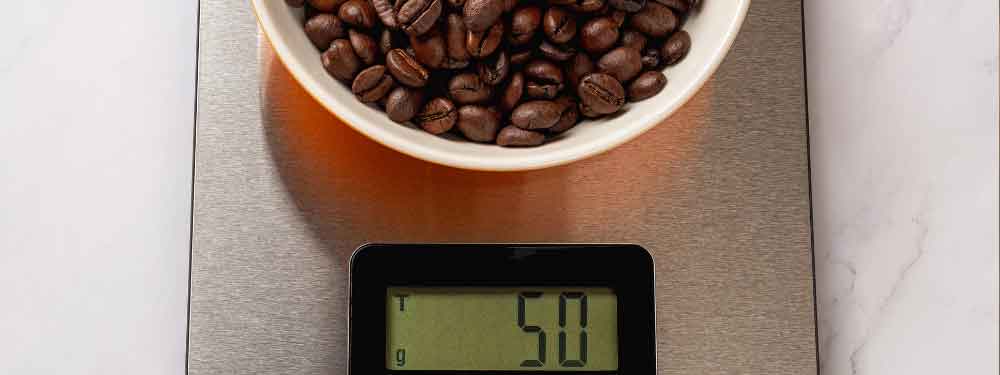
Without overstating it, the quality of a cup of coffee rests largely on achieving just the right balance of freshly ground coffee beans and hot, but not boiling, water. Some would argue the only way this can be done is with a digital scale. But they would be wrong.
Establishing a baseline
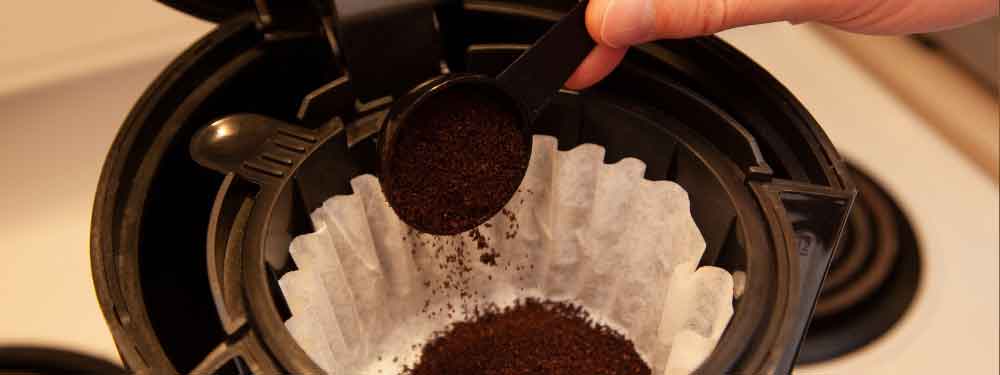
Our goal is 1 leveled scoop (2 tablespoons) of ground coffee for every eight ounces of water. (By “scoop,” we’re referring to the plastic coffee scoop that comes with the purchase of almost any piece of coffee equipment, or even a good bag of beans.)
If you’re ever brewing coffee during, say, a dinner party, scale this ratio and your guests will marvel at their café-quality coffee.
But if you’re brewing for yourself, or yourself and your partner, consider it to be merely a starting point. There are a few reasons for this. For one, the measurement is a bit off. In the U.S. customary system, 1 cup equals 8 fluid ounces. However, the standard coffee cup size is only 6 ounces. And some carafes and coffeemakers mark about 5 ounces of water per cup, assuming that 6 ounces of water will make 5 ounces of brewed coffee.
The takeaway here: always check the measurement marking on a carafe. If it only indicates the number of cups, bank on 5 to 6 ounces of brewed coffee per cup.
Second, not everyone’s taste buds are the same. If you like your coffee on the stronger side, you’re going to need more than 1 scoop (2 tablespoons). Knowing exactly how much more will require some experimentation and patience. Resist the urge to simply double the amount because too much ground coffee could result in a very bitter brew.
Dialing in your ratios
While we promised to avoid using a digital scale in this instance, we feel compelled to note that the scoop method measures coffee grounds by volume, which is not ideal. This is because it doesn’t account for grind size. In other words, a scoop of finely ground coffee is going to contain more coffee than a scoop of coarsely ground coffee, and that difference is obviously going to impact your cup of coffee.
Since different brewing methods entail different grind levels, limit your experimentation to a single brewing method and grind level in order to avoid confusion. Then, once you’ve got it down, feel free to move on to another method and grind level.
Just remember to keep a record of all this on your phone so that you don’t have to keep these numbers straight in your head. No one thinks clearly before that first cup.